This is a pre-print of a work © 2026 by Rebecca Wirfs-Brock, Lise Hvatum, and Klaus Marquardt under exclusive license to Springer Nature Switzerland AG
A preliminary version of this paper was presented idon a writers' workshop at the EuroPLoP 2026 Conference. July 1-5, 2026, Kloster Irsee, Germany.
 Preprint PDF
A small group of experienced conference attendees met at EuroPLoP 2026 to discuss the values of patterns. Not surprisingly the discussions focused a lot on the value of the community as well. This paper summarizes the findings and includes a personal story from each participant as told during the focus group.
Introduction
The following people attended the My Pattern Values Focus Group: Hans Wegener, Philipp Bachmann, Dmitry Ledentsov, Allan Kelly, Michael Weiss, and moderators Rebecca Wirfs-Brock, Lise Hvatum, and Klaus Marquardt (see Fig. 1.).
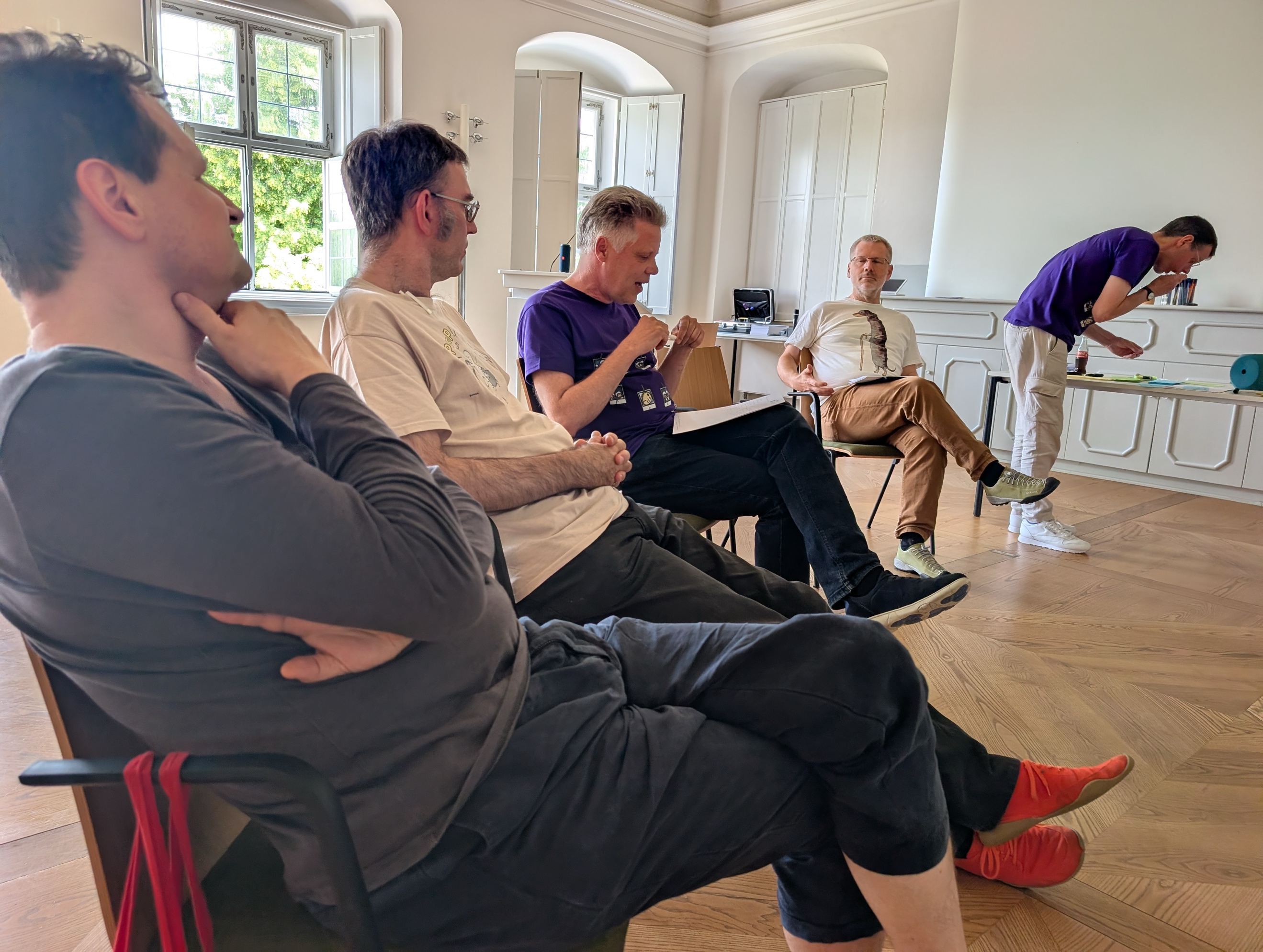
Both the discussion and the outcome of the focus group were influenced by the fact that participants were all long-term pattern community members, some from the very early days of the PLoP and EuroPLoP conferences. The invitation to the focus group is shown in Table 1. We started by asking each participant to tell how they got involved in the pattern community. Our conversation ended up being more about the community values than about the value of the patterns themselves, but we did gather valuable input (see Table 2.) about “The Value of Patterns,” “The Value of Being an Author (of pattern papers),” and “The Values of the (Pattern) Community.”
Table 1 Invitation to the Pattern Values Workshop
| My Pattern Values Rebecca Wirfs-Brock, Lise Hvatum, Klaus Marquardt |
|---|
| Synopsis: As a pattern community, we strive to provide quality patterns and pattern collections to the benefit of those who apply the practices. We deeply believe that these patterns are of value to those who use them. We would like to gain a better understanding of this value.
In a similar way, the patterns community itself has a shared value system that has been carefully developed over many years. We would also like to gain a better understanding of how our community members see and experience these values. The purpose of this event is to collect input from conference attendees about their personal relationship to patterns. Prior Knowledge: None Benefits to participants:Learn about what value patterns bring to their professional and personal life, and what they find to be the value system that drives the pattern community Shared understanding of pattern values for various groups of stakeholders Indirect potential influence on how Hillside Europe and EuroPLoP operate And maybe a write up of community values that can be useful for newcomers |
Table 2. A summary of the values we touched upon: the value of our community, the value to authors, and the value of patterns.
| Value of Community | Value to Author | Value of Patterns |
|---|---|---|
We build a world We have authority as a community “High” cost of entry creates a tightly knit community A community that creates real value (honest, reviewed, shared) Being a fly is a moment of humbleness and being equal Equality - the conference chair is also a fly on the wall Passing forward the favor Non-commercial Healthy mix practitioners/academics Intelligent conversation Sustaining & renewing ourselves Being encouraged Gentleness Feedback as a gift culture Helping others understand Nuance Openness Incredible people Sharing Safe space Belonging Love |
Growth and learning by doing Learn by writing Communication Creating Teaching Seeking truth Curiosity Structured thinking Shepherding Shepherding others makes me a better author Mentoring Support in getting things right (personal - not sterile) Get deep readers -> feedback Feedback Entry fee to community |
Generating solutions Tethered to reality Honesty: Patterns are only complete with liabilities included Focus Priorities |
Our Stories
We began by sharing our stories of how we came to know about patterns and joined the patterns community.
Hans Wegener’s Story
My first contact with patterns was in 1995, when I was just about to leave my student intern post at the German National Research Centre for Information Technology (GMD, now Fraunhofer FIT) in St. Augustin, Germany. My work had focused on the question: do object-oriented design and psychological models of the user interface align? (They don’t.) On one of my last days before my professional career began, a colleague showed me a book and said: “You should definitely read this.” It was the Gang of Four book [1]. Over the next 3-4 years, I was transfixed and bought any related publication I could get my hands on to improve my designs. I became a good customer of Amazon.de. There were hopes of endless flexibility and reuse.
I ended up in the finance industry and in 1998 started work at Ubilab, the technology lab of UBS in Zurich, Switzerland, joining a personal friend there. He knew the people at Object Technology International (OTI, now IBM Research), many of whom were Ubilab alumni and worked close by, so I took in what I heard through network effects, notably how the design of Eclipse was going. Endless flexibility and reuse were still on my mind, though the shine was beginning to come off as I put those ideas into practice. In 2003 I finally decided to leave the software world and moved into data. My intention was to seek relevance: software people seemed too detached from what I perceived to be business concerns, somewhat supported by a parade of industry acronyms promising frictionless design that just didn’t materialize. I never looked back.
What I found in the data world confirmed my suspicion that organizations and people have significantly more impact on the success of technology than the trade glossies would allow: understanding what a design intends, weaving it into daily work, and leveraging its strengths while avoiding its weaknesses were such powerful forces that it motivated me to write my first pattern language on the problem of "slowly changing dimensions," an issue arising from semantic data evolution over long periods of time. Writing it and going through the shepherding process reminded me of my favorite painting, Lyonel Feininger’s “Quiet Day at Sea III,” which I enjoy using as an illustration of how abstraction extracts the essence of a subject while retaining its characteristic form. This process allows me to see my own words through different eyes, refracting points of view I hadn’t been aware of. My writing improved significantly as a result.
I began shepherding patterns around the mid-2000s and, with a small hiatus, have ever since. Shepherding allows me to pass on my experience, which I am grateful to be able to. Through the process I am also forced to reflect on my own way of communicating, which has become more relevant now that I’m part of "management" and converse with colleagues who do not care for tech-babble but need to understand the essence of what I propose. Shepherding also made me more aware of the effects my words can have on people, shifting from wordy explanations to brief, clear statements that cut to the chase. I hope my sheep have experienced that as a positive.
In hindsight, I drifted from a technology-centric to a person-/organization-centric approach, and patterns helped me to integrate that shifting point of view into the way I communicate, explain, and design. I now care less for elegance and more for effect, but my way of writing about it stayed broadly the same.
Philipp Bachmann’s Story
In 1999, right before he finished his doctorate in Mathematics at the Albert-Ludwigs-Universität Freiburg, Germany, Bernhard Schupp presented his research and software to his fellow students explaining as if it were the most natural terms ever: “This is the classical Builder / Factory design pattern.” This was my first encounter with patterns. Some weeks later he served as one of the facilitators of an early Java workshop, where he taught us the surprising effects of the Visitor pattern. These encounters sparked my interest in patterns, so I first purchased the Gang of Four book [1] and the first two volumes in the Pattern Oriented Software Architecture series [2],3].
In April 2002 I screwed up my courage to contact Frank Buschmann, one of the authors of the first volume (and other volumes as well) of Pattern Oriented Software Architecture—he turned out to be quite approachable and quickly replied. This has motivated me to more actively get involved in patterns and pattern languages and resulted in my submission to PLoP 2006, which actually was my second PLoP paper after having had workshopped a C++ idioms-paper building upon ideas by Andrei Alexandrescu at PLoP 2005.
Over the years, content-wise my submissions have evolved from technical to organizational stuff, and style-wise I shifted from more explicit pattern formats more to the dialectical Alexandrian form.
To this day I have always enjoyed the xPLoP and Hillside communities and the bright and diverse minds of xPLoP attendees!
Dmitry Ledentsov’s Story
My first bout with computers and software was in my last school years (1994-1999) where I ended up writing around a couple of hundreds of small programs in BASIC and Pascal to learn, play and put ideas into code. This was an offline time without much access to information, especially the budding communication around the GoF patterns. Having spent a summer holiday "writing" a widget toolkit in the head and then on paper planted the seeds of seeing reusable solutions to problems—as I’ve inadvertently came across some previously.
I returned to software in 2003 with access to the internet, catching up with the software world, coming across Hillside and PLoP websites. Over the years, up until my wish was rejected—to approach Enterprise Integration by at least using the language of the excellent eponymous book by Gregor Hohpe and Bobby Woolf [4]], I got continuously drawn to patterns and pattern collection and languages, yet getting put off by one thing or the other. For example, the word “shepherding" nearly put me off the idea of ever interacting with the pattern community due to its religious connotation—exacerbated by a flashback of a photo seen on the internet—of a group of people on a hill slope, staring into the distance.
One day after seeing Allan Kelly’s “show me the money” I was resolved to meet him in person. When we did meet, many flashbacks suddenly got organized into a consistent set of references, including my workplace, and so I got convinced to visit EuroPLoP. Since my first visit as a "foreign body”—without having a paper—I did feel at home at EuroPLoP 3 times as of now. This time, in 2026 we did touch upon this shape of being at EuroPLoP, and whether anyone feels excluded. If my memory hasn’t failed me, I can’t remember anyone expressing feeling excluded despite the persistent questions “which workshop are you in, and what is your paper about?”
To my own surprise I was completely drawn into the workshops, the focus groups or my proposed BoFs, one of which started to crystallize many of my thoughts into something that could become a paper for a *PLoP one day. For that I’m deeply grateful to Allan for bootstrapping this process, and to Cesare Pautasso for giving me a necessary boost and a nudge, and to all who I had the chance to connect and exchange with, and having landed in this focus group with Rebecca (unbelievable!), Lise (improbable!), Michael (whose patterns I read more than a decade before meeting in person!), Philipp, Allan, Klaus, Hans, has resurrected many ideas that I should finally write down, as I must have repeated them several times in several contexts, including when commenting on the papers I read.
Allan Kelly’s Story
Like so many others my first contact with patterns was Design Patterns [1]from the “Gang of Four.” I think I'd heard about it in Dr Dobbs journal. About this time, I was absorbed in C++ and the C++ community, patterns started showing up at C++ conferences and John Vlissides’ Pattern Hatching column appeared in the C++ Journal.
Still, it was a few years before I was ready to try my hand at pattern writing. I was building a system for a potential start-up and decided to use the same design I'd used a few years before at Reuters. That itself was a copy of a fire monitoring system I'd worked on for Glaxo - Wellcome. I met the rule of three. Could it be a pattern?
I asked my C++ community mailing list, ACCU-General. Kevlin Henney came back and said "I recognize that too but I don't think anyone has written it as a pattern. Why don't you?" Kevlin offered to shepherd, so I was off.
Oddly, this was all in the weeks before return to university to study for my MBA. There probably arent’t many MBA students who have the time, or inclination, to write detailed software design patterns in parallel.
At some point I said to Kevlin, “What next?” and he pointed me to EuroPLoP. I had another round of shepherding from Frank Buschmann—who went on to win the shepherding award that year.
EuroPLoP was like nothing I had ever experienced. The workshop first lifted me up and then crashed me down but I survived. The paper got stronger. So strong it went on to be included in Pattern Languages of Program Design volume 5 [5]].
I was inspired to apply patterns to the kind of business ideas I was learning on my MBA. After eight years, and a dozen conferences, that resulted in Business Patterns for Software Developers [6], which I'm sure would have sold better if I'd called it Software Business Strategy Patterns.
I look back on 2003 for three significant events. In my personal life I started dating the woman who became my wife, what can be better than that? In my professional life I graduated with an MBA and attended my first patterns conference. I now consider EuroPLoP to be the more significant of the two.
Michael Weiss’s Story
My first contact with patterns was when I discovered Alexander’s Timeless Way of Building [7] in a well-stocked architecture bookstore. It took a few years and a call for papers for a patterns workshop at OOPSLA for me to write my first pattern. That was just before the GoF book came out. Shortly after I moved from Germany to Canada to work on an agent-based communications system. Inspired by GoF, we started documenting our own agent patterns. This even led to a tutorial at an agents conference.
This was all before I discovered PLoP and then EuroPLoP. My first paper at a PLoP was in 2001 [9], but my first in-person PLoP was in 2002 (9/11 happened to be when PLoP started in 2001). The shepherding experience for those first papers was extraordinary, and I loved the welcoming atmosphere of the conference. I felt that this was a community I wanted to be part of. I had an opportunity to contribute back in many ways since, first by creating the submission system for EuroPLoP which was adopted by the other PLoPs and that I still maintain, then as a chair of EuroPLoP and later PLoP.
Patterns have shaped my thinking. I learned a great deal about writing and giving feedback from the process of writing patterns and participating in writers’ workshops. Patterns have also greatly influenced my teaching. When I get into a new area, I often write patterns to make sense of it for myself. The biggest value of patterns for me is probably as a way of communicating better.
Rebecca Wirfs-Brock’s Story
I first learned about patterns at Tektronix. A small group at Tek Labs were grappling with how Alexander’s patterns might relate to software (I wasn’t part of that group but kept an eye on what they were doing). Several years later, Addison-Wesley asked me to review a draft of the Design Patterns [1] book. That was an eye opener. That’s when I first saw how design patterns could impact a design. I attended my first patterns conference in 2006 where we presented the Problem Frame Patterns [9]. James Noble had asked me if I wanted to write some patterns together (I was nervous about writing patterns as the patterns form was quite different from how I had written my object-oriented design books.) Writing with James Noble and Paul Taylor was a lot of fun. They introduced me to this wonderful community where I proceeded to get hooked. The genuine way that people in our community offer constructive advice on how to improve our writing and our patterns is amazing. Patterns truly come into focus through much discussion and working out different points of view. I cherish my longtime collaborations with folks in this community. Our thinking and writing together has been deeply satisfying and—surprisingly—energizing.
Lise Hvatum’s Story
My first exposure to the patterns community was when attending EuroPLoP in 2001. I was “sold” immediately because of the welcoming attitude, and the quality of the people attending—so knowledgeable and eager to listen, share, and discuss. The patterns community has brought me years of meaningful engagement and friends from all parts of the world. To me, the primary value of patterns is that they help me structure and communicate knowledge. Linda Rising once told me that when you know patterns you see them in everything around you. Yes, you do.
Klaus Marquardt’s Story
My first EuroPLoP changed my view on patterns. In 1998 a friend and former colleague chaired the conference and asked me to join. When I agreed, Jens suggested that I’d get more out of it if I write a pattern myself. My submission clearly showed that I had no idea why to write, and Neil took me under his wing and introduced me to a new world.
In the workshops, the side discussions, and the heated arguments in the Irsee cellar I found myself a peer to writers and thinkers, that cared to improve their own work and also their social and technical world, that loved to differentiate between different levels of abstraction and implementation, and that valued position, quality, and community.
I never really left. Still the people and the attitude of EuroPLoP thrill me. We have shaped a community of trust, I hear Richard, but also of ambition, intellect, openness, playfulness, and soul. Joining the EuroPLoP community has a high entry barrier: a paper and an attitude to personal growth. Being amongst these people is hard work, and a joy and relief at the same time. The world actually changed, starting in this monastery.
The value system and the feedback mechanisms might be easy to enumerate and describe, but they are surprisingly hard to establish in a work environment. EuroPLoP still is the immersive environment where these values are alive and experienced.
Final Thoughts
It was interesting to hear each participant’s story. They affirmed a strong feeling of belonging to our community. This is maybe not surprising when we consider that all participants are experienced professionals who have attended EuroPLoP several times. But the personal connections and strong feelings of support stand out. So maybe it is not surprising that our discussions focused more on the value of our community, and less on the value of the patterns themselves (the value of patterns was a given). Perhaps the most significant value of patterns is that they bring people together. EuroPLoP is a truly special place where we come to appreciate each other’s work, share our thoughts, make new friends and strengthen existing friendships.
Acknowledgments. The moderators of this focus group would like to acknowledge the participants in our focus group who graciously shared their personal “pattern origin stories” and thoughtfully shared their insights into our pattern community.
Disclosure of Interests. The authors have no competing interests to declare that are relevant to the content of this paper.
References
- Gamma, E., Helm, R., Johnson, R., and Vlissides, J. Design Patterns: Elements of Reusable Object-Oriented Software. Addison-Wesley. (1995)
- Buschmann, F., Meunier, R., Rohnert, H., Sommerlad, P. and Stal, M. Pattern-Oriented Software Architecture Volume 1: A System of Patterns. Wiley. (1996)
- Schmidt, D., Stal, M., Rohnert, H., and Buschmann, F. Pattern-Oriented Software Architecture Volume 2: Patterns for Concurrent and Networked Objects. Wiley. (2000)
- Hohpe, G., Woolf, B.: Enterprise Integration Patterns. Addison-Wesley. (2003
- Manolescu, D., Voelter, M. and Noble, J. Pattern Languages of Program Design Volume 5. Addison-Wesley. (2006)
- Kelly, A. Business Patterns for Software Developers. John Wiley & Sons. (2012)
- Alexander, C. The Timeless Way of Building. Oxford University Press. (1979)
- Weiss, M.: Patterns for e-Commerce Agent Architectures: Using Agents as Delegates. In: Proceedings of PLoP01: Pattern Languages of Programs Conference. (2001)
- Wirfs-Brock, R., Taylor, P., and Noble, J.: Problem Frame Patterns: An Exploration of Patterns in the Problem Space. In: Proceedings of PLoP06: Pattern Languages of Programs Conference, article: 21, pp. 1-19. Portland OR, USA (2006). doi: 10.1145/1415472.1415497