This is a pre-print of a work © 2026 by An Hikino, Takashi Iba, Christian Kohls and Rebecca Wirfs-Brock under exclusive license to Springer Nature Switzerland AG
A preliminary version of this paper was presented in a writers' workshop at the VikingPLoP 2026 Conference. April 9-12, 2026, Lake Jerisjärvi, Finland.
 Preprint PDF
This paper explores what people value in pattern languages and how these values are rooted in their past experiences and personal ways of thinking. Four authors with different professional and academic backgrounds, all deeply engaged with pattern languages for many years, reflected on the values they find in pattern languages and on the roots of those values. Each author first reflected on them and wrote a narrative; the authors then read and responded to one another’s narratives, and each author reflected again on their experiences in light of the responses. Through this dialogical and mutually reflective process, it became clear that the authors find distinct yet overlapping values: being able to personally participate in creating what one does and uses; recognizing the insights embedded in the process of creating something excellent; beauty and elegance in solutions; and a language for talking about designing at a higher level. At the same time, the dialogue revealed a sense shared by all four authors: “sharing newly gained knowledge and understanding with others, creating together with someone, and thereby helping others.” Even for authors who had been meeting in the same community for many years, much about one another’s roots was unknown, and digging into oneself led not only to self-discovery but also to new discoveries about others and to deeper relationships. The paper thus offers first-person accounts of why pattern languages matter to those drawn to them, and it demonstrates the richness and potential of the dialogical and mutually reflective method adopted here.
1. Introduction
The authors of this paper have been conducting research that seeks to understand what meanings and values people find in the ideas and philosophy of pattern languages. For example, Wirfs-Brock and Kohls [26] propose a perspective that reconsiders the value of pattern languages not as a property inherent in the patterns themselves, but in relation to the contexts (Umwelt) shaped by people’s perceptions, experiences, and values. Hvatum and Wirfs-Brock [8] reflect on their own experiences to discuss what meanings and effects patterns can bring to people and their practices.
The authors have also conducted studies that describe the value and development of pattern languages by reflecting on individual experiences and histories. Iba [9] traces how pattern languages expanded from architecture to software and further into the domain of human practices, drawing on interviews with key figures and on his own experiences. Hikino and Iba [7] interview five people fascinated by the ideas and philosophy of pattern languages and clarify which aspects of pattern languages they value and from what experiences and ways of thinking these values arise.
That interview study suggests that the values people find in pattern languages differ from person to person, and that where and how one finds value is connected to one’s experiences since childhood and to the ways of thinking and values formed and reinforced through them. Building on these studies, we thought that unraveling and sharing the values and roots of people who have long been engaged with pattern languages could not only deepen their self-understanding but also lead to the discovery and understanding of deeper values of pattern languages.
In this paper, therefore, four authors reflect on what values they find in pattern languages and through what experiences and ways of thinking these values have come about, share these reflections with one another, and explore them collaboratively. The four authors are An Hikino, who studies people fascinated by pattern languages; Takashi Iba, who has studied pattern languages for human practices for more than twenty years; Christian Kohls, who has long worked on socio-technical systems, learning with digital media, and the development of environments and tools that support creativity; and Rebecca Wirfs-Brock, who has a long career in software design and the development of software design methods.
This paper makes two contributions. First, it presents, as four first-person narratives, what four authors who have long been engaged with pattern languages value in them and where those values originate. Second, it shows how a dialogical and mutually reflective process deepens such self-understanding and reveals what the authors share. The remainder of this paper is organized as follows. Section 2 describes the research design and introduces the authors. Section 3 presents each author’s narrative, and Section 4 presents the authors’ responses to one another and their re-reflections. Section 5 discusses the findings, and Section 6 concludes the paper.
2. Research Design and the Authors
Method and Process
Overview
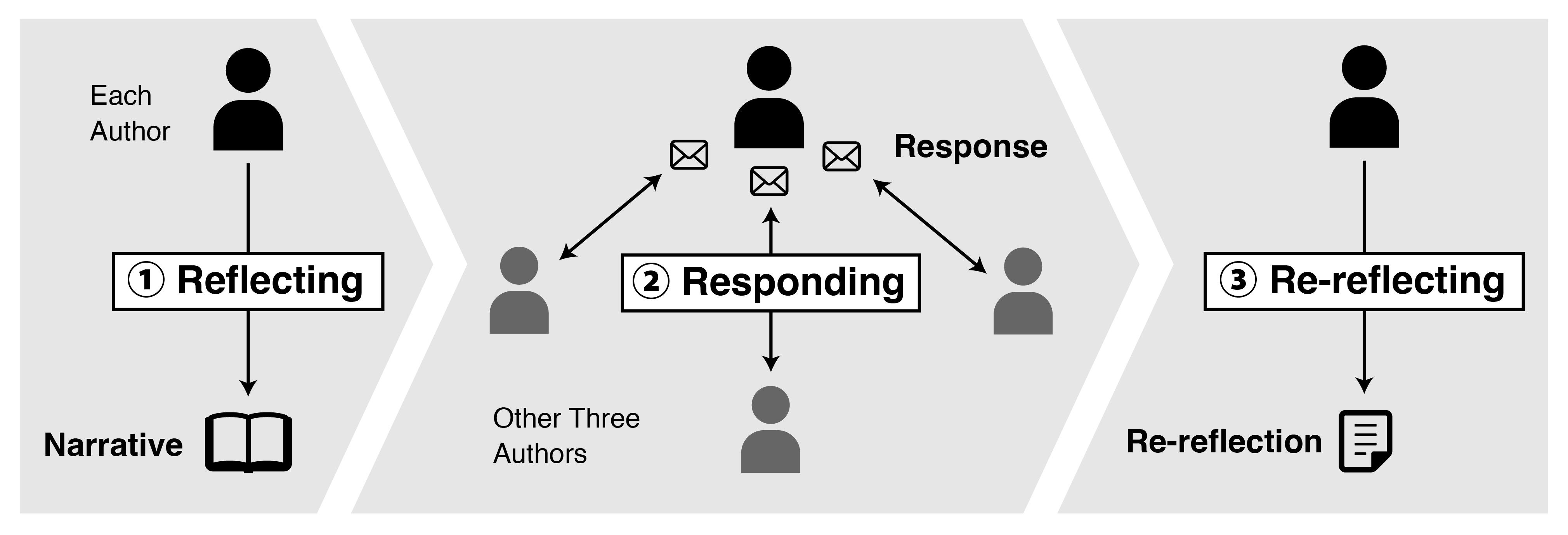
This study was conducted as a dialogical and mutually reflective qualitative inquiry consisting of three steps (Fig. 1). In Step 1, each author reflected on their own experiences from a first-person perspective and wrote a narrative. In Step 2, the authors read one another’s narratives and wrote responses. In Step 3, each author reflected again on their own experiences in light of the responses they had received. Steps 2 and 3 can be repeated; in this study one further round of exchange took place, and it is presented as a follow-up response. Throughout this paper, we call the writing produced in these three steps a narrative, a response, and a re-reflection, respectively. We adopted this method because the aims of this study are to deepen self-understanding by reconsidering what values each author finds in pattern languages and how the self that finds such values has been formed, and to gain new insights through dialogue among the authors.
This method shares features with collaborative autoethnography (CAE), a qualitative research method in which multiple researchers bring their own experiences as research data, share them, and analyze them jointly through dialogue [4]. In this study as well, the four authors opened up about their experiences, read one another’s narratives, and responded to them, thereby generating new understanding. Rather than presenting the resulting findings and insights in summarized form, this paper follows the actual course of the reflection, so that readers can see the process by which understanding gradually deepened through mutual reading and responding.
Step 1: Reflecting
Each author reflected on the values they find in pattern languages and on the past experiences and thoughts behind those values, and wrote them down as a personal narrative. First, each author reflected on what they value in pattern languages, such as the aspects they like or find interesting. Next, each author reflected on the experiences that led them to resonate with those aspects of the worldview and philosophy of pattern languages that they had identified as valuable, and explored what thoughts they had gained through those experiences. In this process, the first author conducted a text-based interview with each of the other authors, so that they could dig into experiences and thoughts of which they had not previously been clearly aware.Step 2: Responding
The authors read one another’s narratives and wrote responses describing what they thought and felt about them. Each author thus received responses to their own narrative from the other three.
Step 3: Re-reflecting
Each author read the responses to their own narrative and wrote a re-reflection on their experiences and thoughts in light of them. Steps 2 and 3 can be repeated: when reading another author’s re-reflection gave rise to new insights, a further response was written, which we call a follow-up response. One such follow-up response arose in this study and is presented in Section 4.5.
The Authors and Their Work
This subsection introduces the research and activities in which the four authors have been engaged. This background will help readers understand the narratives in Section 3 and the responses in Section 4 more deeply and relate them to each author’s work.
An Hikino is a master’s student at Keio University who has been creating and studying pattern languages in Takashi Iba’s laboratory for about four years. She has participated in collaborative research projects commissioned by companies and has been involved in creating several pattern languages [12, 15]. In her own research, she has interviewed creators who value pattern languages, exploring which aspects they value and in what past experiences and thoughts those values are rooted [5, 7]. Within the laboratory, she also continues practice-based research on creating and updating a local pattern language that helps members work with vitality and collaborate well.
Takashi Iba is a professor at Keio University. For more than twenty years, together with his students, he has studied and created pattern languages that support people’s creative practices [9] in a wide variety of domains, such as learning, dialogue, collaboration, career choice, planning, presentation, and elderly care. Beyond creating pattern languages, he has developed, refined, and systematized the process of creating them and shared it as a methodology [10]. He has also explored new and attractive ways of delivering patterns, such as expressing them in manga and songs [13]. He has been continuously involved in organizing the PLoP family of international conferences.
Christian Kohls is a professor at TH Köln who has long worked on socio-technical systems, design patterns, learning with digital media, and the development of environments and tools that support creativity. His early pattern work addressed the visual design of interactive information graphics [17]. He went on to examine the theoretical foundations of patterns—their structure and qualities, their level of abstraction, their wholeness, and their qualities as gestalts [18, 19]—and developed this into a theory of design patterns in his doctoral dissertation [20]. He has also studied the design of hybrid creative and learning spaces that merge physical and digital spaces [21, 30]. He has been continuously involved in organizing PLoP and EuroPLoP.
Rebecca Wirfs-Brock is the founder of Wirfs-Brock Associates and, as a pioneer of object-oriented design, invented Responsibility-Driven Design (RDD). RDD is a design approach that views objects in terms of their roles, responsibilities, and collaborations, and she is also a co-author of Designing Object-Oriented Software [29] and Object Design: Roles, Responsibilities, and Collaborations [27]. In recent years, she has been re-examining the nature of heuristics in software design, reflecting on her own experience to consider why designers arrive at their decisions and how they explore and choose among alternatives [23, 24]. She has also been reconsidering what value patterns and pattern collections themselves have for their users [25]. In the pattern community, she has long been involved in the activities of The Hillside Group and has led initiatives such as the BootCamp, which introduces first-time participants to pattern languages.
Relationships among the Authors
This subsection describes how the authors are connected and the relationships within which the mutual reflection took place.
The four authors have met at PLoP (Pattern Languages of Programs, People, and Practices) and other international conferences on pattern languages, and have engaged in ongoing dialogue about pattern languages. In particular, Iba, Kohls, and Wirfs-Brock have been part of the same pattern language community for about twenty years and have exchanged ideas throughout that time. Hikino began her research under Iba about four years ago and subsequently came to interact with Kohls and Wirfs-Brock through her participation in PLoP.
The impetus for this study was a workshop that Hikino and Iba held at PLoP 2025 [6]. In this workshop, participants reflected on what values they find in pattern languages and what roots lie behind those values. Kohls and Wirfs-Brock also took part, and because all four found one another’s reflections intriguing, they decided to reflect together and write up what emerged as a study.
3. Narratives
This section presents the values that the four authors found in pattern languages through reflection, together with the experiences and thoughts that form their roots.
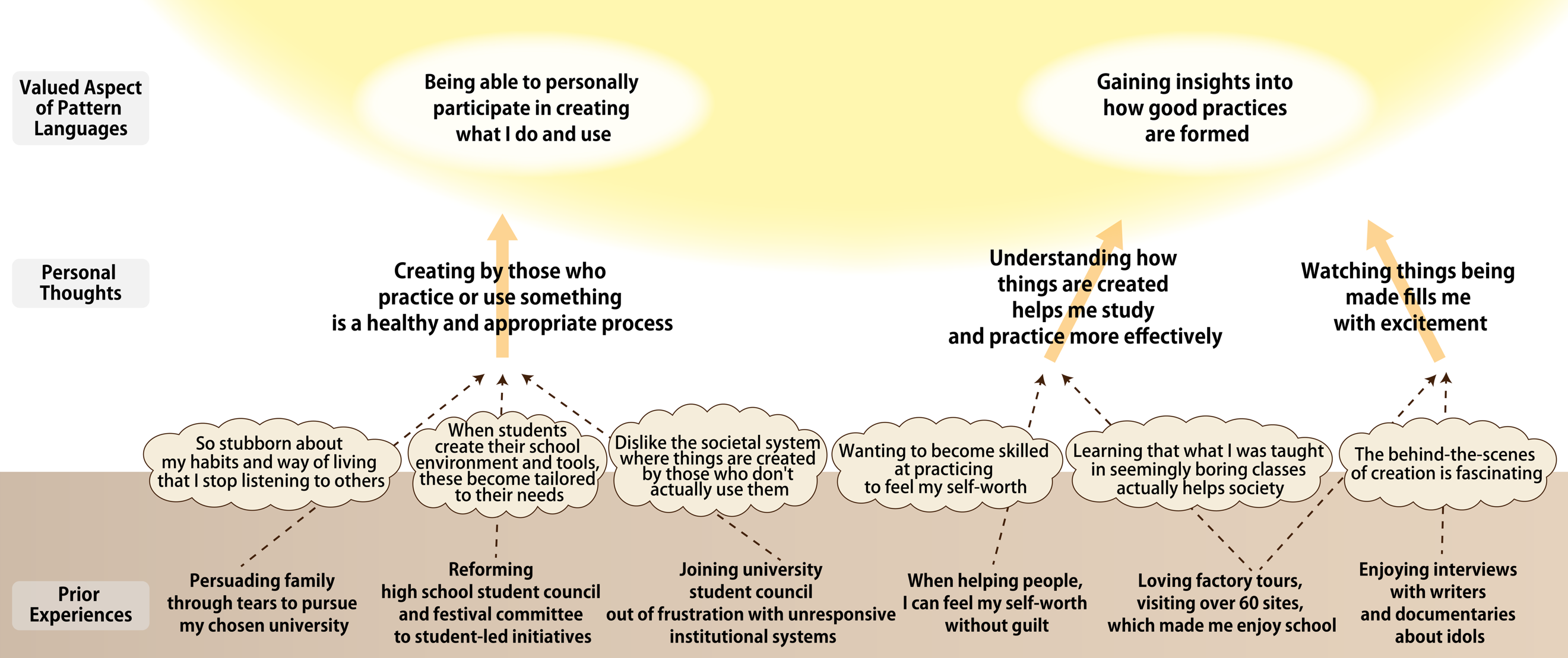
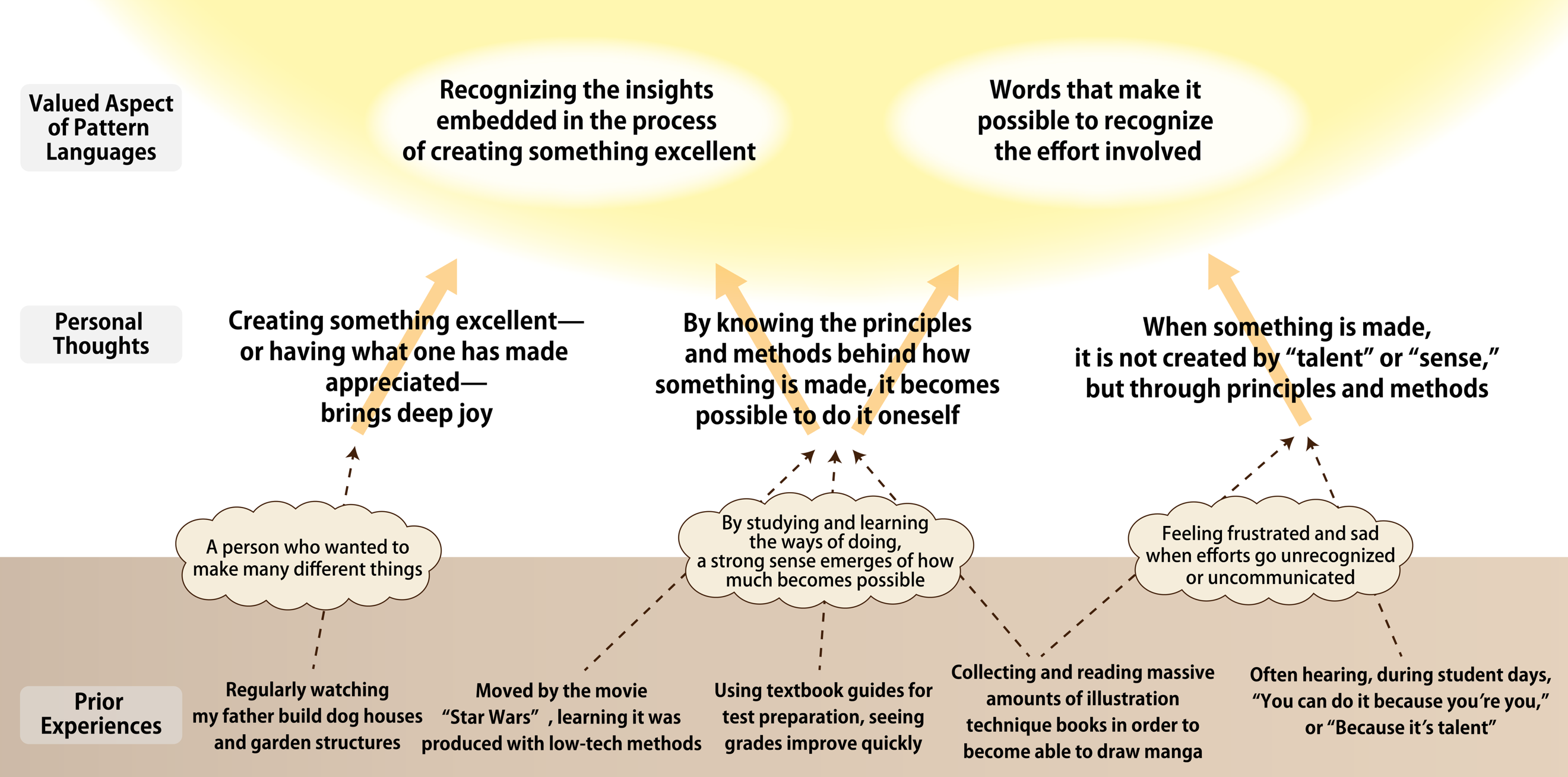
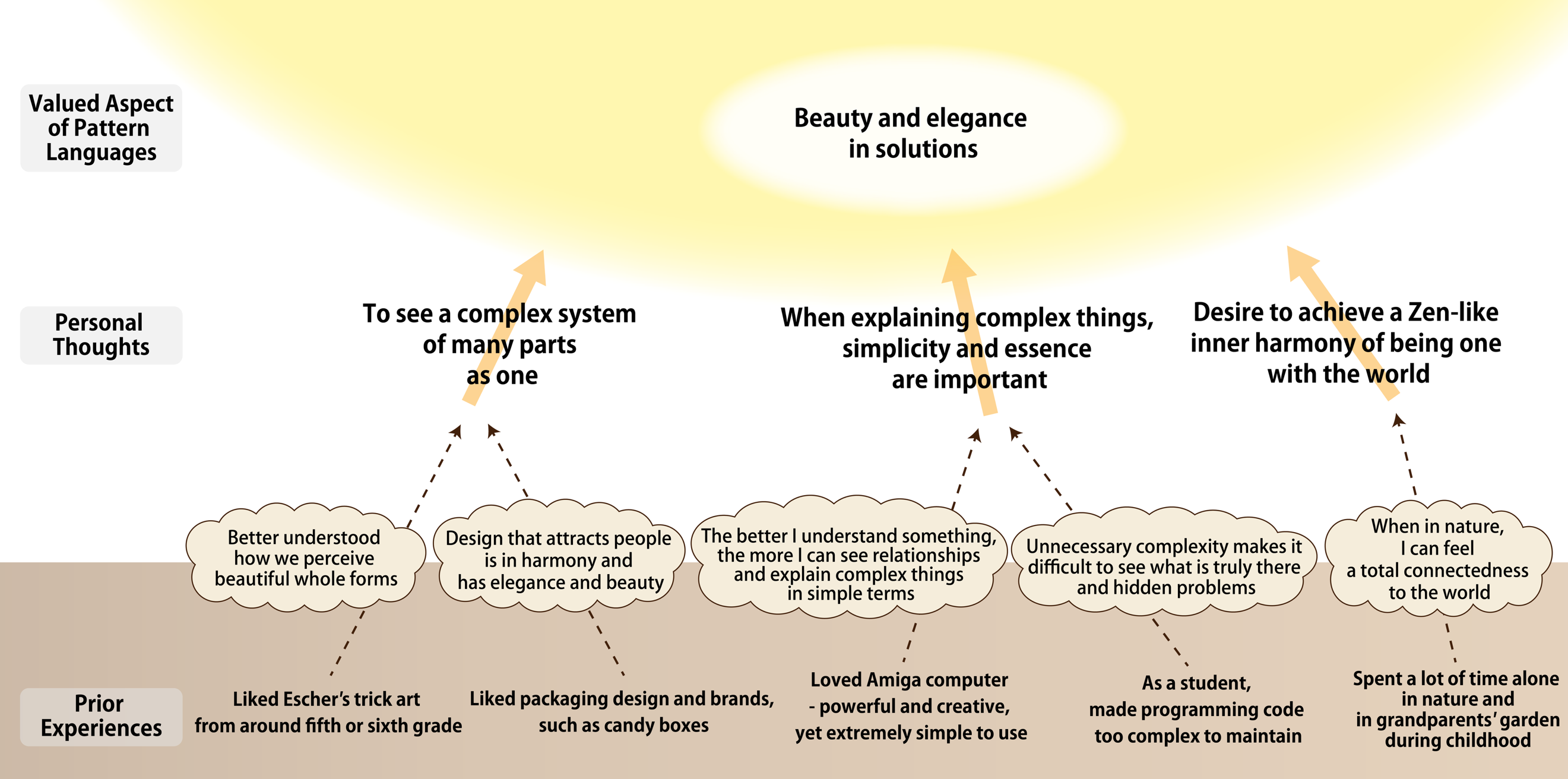
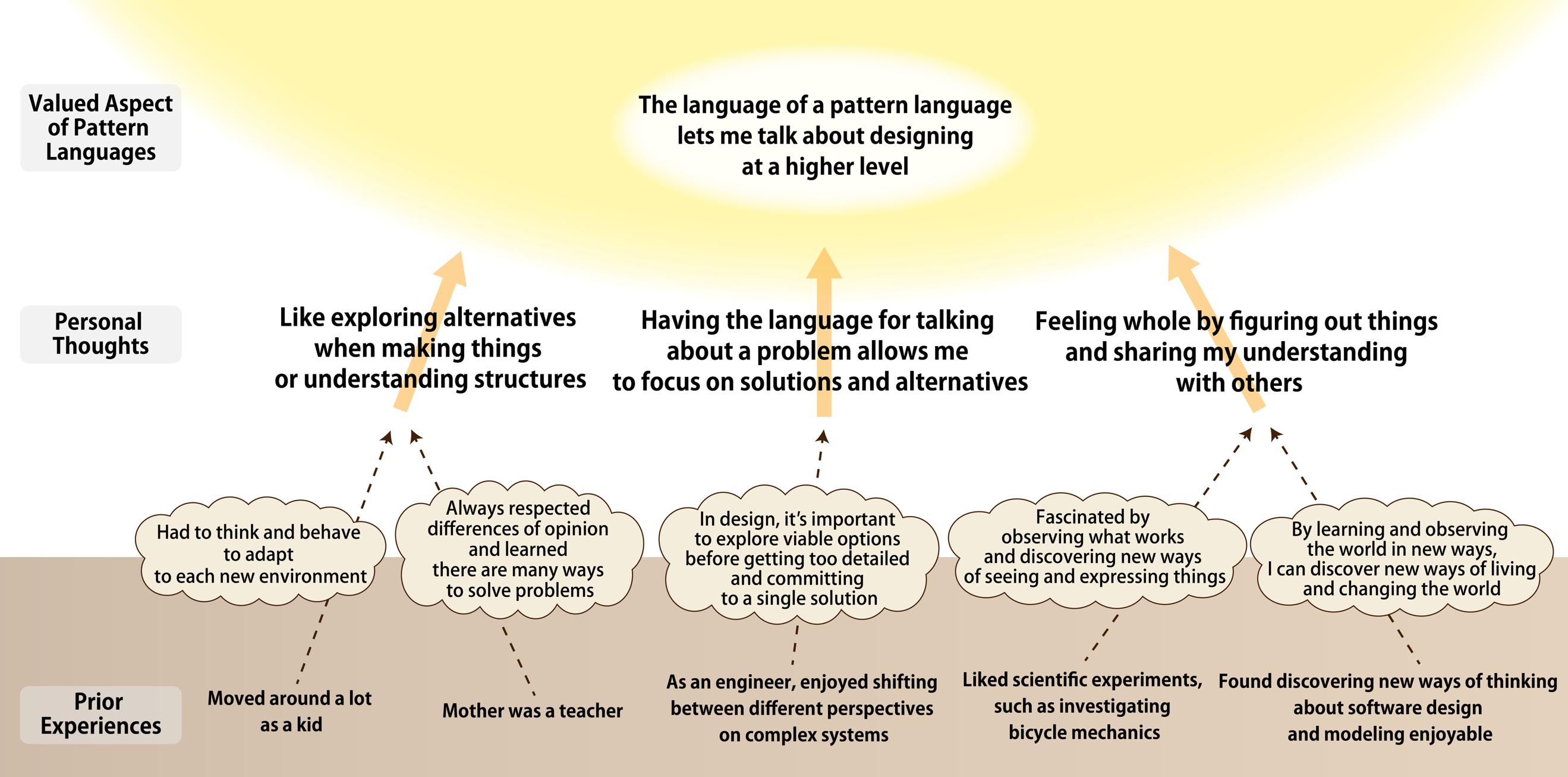
The figures in this section illustrate the relationships among “Prior Experiences,” “Personal Thoughts,” and “Valued Aspect of Pattern Languages.” The band at the bottom of each figure represents Prior Experiences. The cloud-shaped objects above it represent the meanings attributed to those experiences. The arrows extending upward represent the Personal Thoughts formed through reflecting on those experiences, and the circular areas of light at the top represent the Valued Aspect of Pattern Languages.
The following subsections present each author’s narrative. To present each author’s experiences and thoughts in their own words, we have written the narratives in the first person (“I”).
An Hikino—Being Able to Personally Participate in Creating What I Do and Use / Gaining Insights into How Good Practices Are Formed
Since childhood, I have been so stubborn about my own habits and way of living that I would stop listening to the people around me. In high school, after discussing it with my family, I had planned to aim for a university through a school recommendation, but I suddenly found a different university and felt that I absolutely had to go there, even though it meant a much harder path. In the end, in tears, I persuaded my family, who had opposed the idea, and decided to aim for that university through the general entrance examination.
In high school, I also belonged to the student council and the school festival executive committee, where I planned and ran school events, including the school festival. At that time, I pushed forward reforms so that students alone could handle tasks that teachers had previously done, such as briefing sessions for participating groups and the auditions for selecting which classes could sell food. From then on, I came to think that when the students who actually live the daily life of a school create its environment and the things they use, the results suit them better.
After entering university, however, I was devastated by the unreasonableness of a course registration and selection system that was hard to use, did not reflect the opinions of the students who used it, and that we had had no part in creating. I therefore joined the university’s student union, sympathizing with its ideal of creating our own campus ourselves. I disliked the social mechanism in which things are made by people other than those who actually use them.
Through these experiences, I came to believe that it is healthy and appropriate for those who practice or use something to be the ones who create it. Looking back, I think this is why I was attracted to pattern languages, which allow people to participate in creating what they themselves do and use.
Since childhood, I have also loved factory tours and have visited more than 60 factories. On these tours, I liked seeing what I had learned in dull school classes actually being used in society. For example, at an oil refinery, I was deeply moved to see the mechanism of “distillation,” which I had seen in my science textbook, taking place right before my eyes. From that time on, I understood that school lessons have meaning, and I became more committed to studying.
What is important here is the negative belief that serves as my driving force. I feel that I have no value as a person unless I am useful to others, and I feel guilty when I am not. Therefore, I always want to be able to do everything well so that I can be useful to others. From my love of factory tours, I know that understanding how things are made helps me study and practice well, so I always want to know how they come to be.
I also like interviews with writers and documentaries about idols; watching things being made excites me and sparks my curiosity. I have also visited more than 60 factories simply because it is fun. For these reasons, I find value in pattern languages: they let me see behind the scenes of how good practices are made.
The narrative above is summarized in Fig. 2.
Takashi Iba—Recognizing the Insights Embedded in the Process of Creating Something Excellent / Words That Make It Possible to Recognize the Effort Involved
From elementary school onward, I was someone who always wanted to make things. After experiencing the joy of clam digging at the seaside, I wanted to relive that experience, so I created a large shallow pool in my garden, scattered shells in it, and tried to recreate clam digging. I also made various crafts using cardboard and paper. I believe this everyday sense of “making” was nurtured by watching my father build dog houses out of wood and take care of landscaping and gardening by himself.
One particularly formative experience was watching Star Wars: Episode VI – Return of the Jedi in a movie theater when I was in my first year of junior high school. I was deeply excited by the grand spectacle unfolding in outer space. Although it felt incredibly real, I knew that it was actually filmed on Earth, and that the starfighters and bases did not truly exist. I became intensely curious about how such realistic images could be created. I spent my New Year’s gift money to buy a thick and expensive Star Wars “making-of” book—quite costly for a junior high school student—and as I unraveled its secrets, I discovered that many scenes were created using surprisingly low-tech techniques. This fascinated me even more. By cleverly applying ideas that seemed within reach, they had created such an attractive world. From that moment on, I began to dream of becoming a film director.
Around the same time, I acquired my own personal computer. Every day, I taught myself programming and created games to play. I could build my own world inside the computer and design everything that could happen there. Because I could only use eight or sixteen colors and the resolution was low, I relied on visual illusions—for example, alternating black and red dots to make brown appear—to create plausible graphics. I immersed myself in making games that felt convincing. Even before that, I had played games on Nintendo’s Family Computer (Famicom), which now seems extremely primitive. Yet with a bit of effort, I realized I could create games similar to commercial ones myself. I carefully observed existing games to understand what made them feel “right” and enjoyable, and then tried to recreate those qualities in my own work. I did this almost every day—often spending most of the time debugging unexpected behaviors and errors. Looking back, I believe that this debugging process helped me develop abductive reasoning and the patience to persistently think through problems in order to achieve high-quality results.
During those same junior high school years, I suddenly became good at schoolwork. This shift began when I discovered explanatory guidebooks for textbooks in a bookstore. By thoroughly studying them, I came to be able to answer exam questions and eventually rose to the top of the school. I realized how much I could understand, and how much I could do, simply by reading explanations of and supplements to what was written in the textbooks.
Because I wanted to create good things, I enjoyed reading and watching documentaries about how excellent works and products were made, as well as essays, interviews, and commentaries by authors, designers, and creators. Whenever I learned something from these materials, I tried to apply it in my own projects. Once one understands the principles and methods behind how something is made, one can begin to make it oneself. I believe this idea is deeply connected to the philosophy and thinking behind pattern languages. This has remained unchanged from my early teens to the present day. Even recently, because I want to learn how to draw manga, I have collected and read many books on drawing manga and creating appealing illustrations. I have also studied many isekai anime in order to write original stories in that genre. By studying people who can already do these things, and the works they have made, I want to learn from them and become able to create such things myself.
Making something is a painstaking and demanding process that involves many difficulties, but when something wonderful is completed, the joy is immense. It is also deeply gratifying when others say that what I have made is “really good.” I find this more satisfying than being praised personally (which feels somewhat awkward). What makes me happy is having others appreciate something I created—something that I myself also believe is wonderful. Perhaps there is a kind of desire for recognition directed toward the created work itself.
At the same time, since my student days, friends have often said things like “You could do it because you’re Iba” or “You could do it because you’re talented.” Although such comments might sound complimentary, internally I felt frustrated and thought, “No, that’s not it.” I resented it because I had not been able to do these things at first; I learned them through effort, struggle, and persistent hard work. Having the results of that effort dismissed as mere “talent,” as if the ability were something innate, felt deeply unsatisfying. Over time, however, I also came to understand that this perception is somewhat inevitable. When people see something they cannot do themselves, it can only look like a sorcerer’s “magic.”
That is why I try to open up as much as I can both how I create and the making-of behind what I create. I show the effort involved and explain the key points of the creative process. I want to show that it is not “magic” performed by a sorcerer with magical powers, but a “magic trick” performed by a conjurer, with secrets and mechanisms behind it. Things are not created by “talent” or “sense” alone; they are created through principles and methods (with talent or sense contributing to their flavor or expression). I have long held this belief, and for me, a pattern language is a way of making this explicit, and also a language that makes it easier to recognize and communicate them.
In this sense, for me, a pattern language is a warm and gentle medium that reveals the secrets behind being able to make things, enables others to do so as well, makes them want to try, and watches over the hard effort that follows.
The narrative above is summarized in Fig. 3.
Christian Kohls—Beauty and Elegance in Solutions
I am a very visual person, and probably from around fifth or sixth grade, I liked Escher’s trick art. That was when I first understood that perception can be easily misleading. I learned how a gestalt—what we perceive as a single form—can be deeply misleading. Paradoxically, this very capacity to mislead helped me understand more deeply how we perceive beautiful whole forms.
Escher’s work is quite clean. It contains geometric shapes and forms that construct natural forms. And when one looks closer, one realizes these things are impossible. There is ambiguity. Escher’s work has a deep interlock (and here I am intentionally using a concept Christopher Alexander presented as one of the fifteen fundamental properties of life [2]), and I want to see this deep interlock between context and form, between problem and solution, between figure and ground. In my experience, beauty and elegance make it easier to organize parts and add multiple layers of meaning to the solution’s form.
I also liked packaging design and brands, such as candy boxes. Whenever I was on vacation, I liked to bring home many chocolate bars and snacks. In the end, I never ate all of them, but I liked to have these things in my room and look at them. Later, when I was an intern at an agency doing package design, I realized that I was actually more interested in the packaging itself than in its contents.
Many people might think they need to include many attractors in packaging to draw attention to their product. These are exactly the things that attract me, so I naturally pay attention to them. I also like beautiful fonts and letters. So, I think packaging design is ultimately about attractiveness. If a package is not in harmony, lacking elegance or beauty, people won’t buy the product. That’s why I think I liked graphic design and packaging design.
Moreover, I like explaining complex things in simple terms and I value simplicity and essence. Japanese and Scandinavian designs are good examples. They are straightforward and tidy, yet at the same time interesting, easy to understand, and comfortable to be around (cozy, or with a sense of respect for the place). I also really liked the Amiga computer. It was very powerful and creative, yet very simple to use.
As a student, I was a good programmer. But at some point, my programs stopped running. The programs were too complex, with too many mistakes, and I couldn’t figure out how to fix them. This was because I made the code too complex. I created too many links between different parts, making the code unmaintainable. Patterns not only provide solutions but also make me aware of “what is wrong” and “what needs to be fixed.” Many things that are wrong are hidden, making them very difficult to find. That’s why one needs someone or something to point out the problems so that one can take corrective action.
The better I understand something, the more I can explain even complex things in simple terms. To truly explain a complex solution, one needs to see the relationships, and to see these relationships, one must understand all the parts. On the other hand, if the explanation is not simple, I probably still don’t fully understand “how the parts relate to one another.” I think the only way to provide a good explanation is to see higher levels of order. For example, one needs to understand the “concepts” within a complex system. One must perceive the whole system while simultaneously understanding its subsystems or sub-wholes. In other words, it means seeing a complex system of many parts as One.
I can understand complex systems, but simple things are always much more attractive to me. So, I like simple movies or popular movies where the story is not too complex, and I’ve watched many. When I say “simple,” I don’t mean movies without meaning or without surprises. I just like works where good stories are told plainly. And I like how simple things can unfold into more beautiful things.
To make something beautiful, one has to get the decoration right, and movies need details to feel more realistic. But I don’t want to think about these things; I just want to perceive them as one whole.
I have a desire to achieve a Zen-like inner harmony—being one with the world, not just being in the world. When I’m in the mountains or by the sea, I can feel this total connectedness to the world. Every wave at the beach gives me that harmony. If I could transport this harmony to software or organizational design, it would make me happy. This sensation might have been cultivated by spending a lot of time alone in nature and in my grandparents’ garden as a child.
Therefore, I find the value of beauty and elegance in the solutions of pattern languages. When I see beautiful or elegant things, I feel very relaxed and comfortable. On the other hand, if there’s no beauty or something is missing, it creates a sense of “disorder.” Moreover, without beauty or elegance, I tend to overthink. Unnecessary complexity makes it difficult to see the form, the style, and what is truly there.
The narrative above is summarized in Fig. 4.
Rebecca Wirfs-Brock—The Language of a Pattern Language Lets Me Talk about Designing at a Higher Level
We moved around a lot when I was a kid. So, I frequently had to make new friends. Since my father was a school principal (and for seven years during grade school and middle school he was my principal), everyone knew who I was. I always stood out, even when I simply wanted to blend in. Kids form groups and cliques. To fit into these groups (and I did want to belong), I needed to figure out what they valued, what their “rules” were, and decide whether I could naturally blend in or how I could adapt to better fit in. I never felt a strong sense of identity with any particular group. I could move between the smart kids and the athletes and the troublemakers. It was a matter of how much effort I needed to exert to be “let in” and participate.
My mother was a teacher. From her I learned that there are many ways to solve problems—and that solutions can come from unexpected places. She always respected differences of opinion and shared her excitement for learning. I think her attitude toward life had a strong influence on me. Once, for two weeks she was the substitute teacher for my seventh-grade class. As a teenager, the last thing you want is for your mother to be your teacher—how embarrassing! However, I survived. And my friends didn’t abandon me. I clearly remember a moment during a math lesson she taught. A boy, typically not considered very capable by our regular teacher, came up with a creative solution to a problem. Instead of correcting him and telling him the “right” way to solve the problem according to the math book, my mother took note of his equally valid solution. She asked how he came up with it and enthusiastically stated to the entire class: “This is also a good method.” I still remember that.
I like exploring alternatives and understanding how things are built. As a child, I did not make many things out of parts—I did not have an erector set and I did not make model airplanes. But I liked to know how things worked. I wanted to know the “why” behind the “how.”
I remember scientific experiments from childhood. In second grade, we all planted bean seeds in cups and observed their growth, drawing pictures—which I found very enjoyable. At six, I did a somewhat ridiculous experiment. While riding my bicycle, I noticed that as I sped up, the spokes seemed to disappear. So, I wondered, “Did they vanish?” As an experiment, I stuck my foot into the wheel while riding. I quickly realized the spokes were still there, just invisible! I skinned my knee. When I showed my mother my bloody knee, she didn’t believe I was hurt. That was because just a couple of days earlier, I had experimented with faking a wound by rubbing berries on my knee. In high school, I loved chemistry class. I genuinely enjoyed the surprising things that happened when mixing substances.
I’m still attracted to discovering new perspectives and observing effective mechanisms. By learning and observing the world in new ways, I believe we can find new ways of living and changing the world in positive ways. I’d like to mention an essay I wrote with my colleague Mathias Verraes, “Critically Engaging with Models” [28]. In it, we observe that all models—whether for a software system, a development process, a disease, a political system, or plant growth—present a way to look at (a part of) the world. Models typically explain how something works and how to modify that behavior. Every model makes a choice about what matters (its basic building blocks), what is worth observing, what is valued, and even what is valid to do within that model. That’s one big reason I am attracted to patterns—they offer ways (that is, models) for how to affect part of the world. But they are also, by design, open-ended—all patterns are expected to be adapted by their users to their specific context.
Importantly, the language that patterns provide for discussing design problems allows me to focus on solutions and alternatives. If I have this kind of pattern vocabulary to express design ideas, it becomes easier to compare and contrast alternatives. Design is an iterative process that starts with rough ideas and gradually becomes clearer as details are refined. However, it’s important to explore viable options before getting too detailed and committing to a single solution.
Therefore, I find value in pattern languages because they allow me to talk about design at a higher level. By design, I mean all kinds of design, though software design first comes to mind. I think similarly about architectural design. For instance, we spent two years designing our house with architects who were familiar with Christopher Alexander and software design, so I had many conversations with them about both types of patterns.
I aspire to be thoughtful, empathetic, and caring. I also value thinking. Understanding things and sharing that understanding with others makes me feel fulfilled.
The narrative above is summarized in Fig. 5.
4. Responses and Re-reflections
This section presents the responses written in Step 2 and the re-reflections written in Step 3. Sections 4.1–4.4 are organized by author and correspond to the four narratives in Section 3.
Each subsection first presents the responses from the other three authors, and then the re-reflection by the author of the narrative. Section 4.5 presents the one follow-up response written by Iba after reading Hikino’s re-reflection. In what follows, the authors refer to one another by their first names (An, Takashi, Chris, and Rebecca) or as “you.”
An Hikino’s Narrative
Response from Takashi Iba
In An’s account, what first surprised me was the very first sentence: “Since childhood, I have been so stubborn about my own habits and way of living that I would stop listening to the people around me.” I thought, “Really!” It is hard to imagine from her gentle manner today, but on reflection, it may be connected to her strong core, her determination to carry through what she believes is important. Her move, after entering university, from despair at existing systems to asking whether she and others could do something themselves is exactly what Alexander did in architecture and town planning; in that respect, there was probably an unconscious resonance when she encountered pattern languages.
Regarding factory tours, I strongly empathize with her attentiveness to the making processes behind everyday objects and to the principles employed there. I also enjoy interviews with creators, and while I have not specifically watched idol documentaries, I am generally drawn to such genres. At that level, there are probably many people who share similar interests. However, what struck me as particularly characteristic of An was her sense that even school classes can be meaningful. Reflecting on this led me to recall that pattern languages are not merely about noticing or pointing out underlying principles, but about seriously investigating them, studying them, and explaining them carefully. They are not simply a presentation of the fact that things are made in a certain way, but an attempt to trace such phenomena to the level of essence—where the same patterns repeatedly appear across different contexts. In that sense, pattern languages may indeed share affinities with school subjects, which also aim to articulate and systematize such recurring structures.
An’s mention of “the negative belief that serves as my driving force” was interesting to me, as it is a feeling I do not have myself. Her words “I feel that I have no value as a person unless I am useful to others, and I feel guilty when I am not. Therefore, I always want to be able to do everything well so that I can be useful to others” made me think, “I see, so that is how she has been thinking,” and deepened my understanding of her. Personally, I would like to tell An that it is not true that she has no value unless she is useful to others; yet since this feeling serves as her driving force, I also felt that it is a good thing.
What I found important in this passage was the word “everything.” If it were enough to excel at one thing, one could probably enter a field, gain experience, and master it. But it is impossible to do this for everything. That is exactly why something like a pattern language is needed. I often describe pattern languages as something that “supports creative practice in many different domains,” in the sense that they “increase the freedom of creative practice.” In one book, I wrote that “rather than seeing each person as an indivisible atom, it is more natural and better to see each person as a ‘composite engaged in many creative practices’” [14, p. 88], and introduced pattern languages as follows: “Everyone must have many things they want to do, including very small ones. In many cases, people hesitate, thinking ‘It’s impossible for me’ or ‘It seems difficult,’ but otherwise there are many things they would like to try. … What supports people so that they can take a step forward at such times is a ‘pattern language’” [14, p. 91] (our translation).
I describe pattern languages in this way because I have a curiosity that makes me want to do many different things. What I found interesting, however, is that An arrived at the same place by a different path, one based on self-worth and guilt. I learned that even when people find value in the same thing, there can be different routes leading to the same summit.
Response from Christian Kohls
In An’s story I can see three driving factors that resonate with patterns and pattern languages. First, throughout her life she has fostered (even fought for) participation and put the design process into the hands of the actual actors and users. This is reflected in her personal design decisions (making her own choices) and her voluntary work in local politics (such as being a member of the student council). Not following the ideas of others but expressing and creating your own environment is deeply rooted in Christopher Alexander’s idea of enabling everyone to build better towns, neighborhoods, and buildings.
Second, An is driven by an urge to help others. Yet this help means not just creating for them but with them; patterns and the way of seeing through the lens of pattern languages help her to co-create with others and adapt organizations, tools, and environments to the actual needs of peers.
Third, while she appreciates the theoretical workings behind things (e.g., school knowledge and textbooks as well as getting insights from interviews), her interest lies in the actual impact on the world, as her many factory visits show. She understands that the knowledge captured in pattern languages can help to connect the theory with the practical and beneficial application. Patterns help her to create solutions and engage with others to do so.
Response from Rebecca Wirfs-Brock
An, you seem to share two characteristics that I also have: caring about making useful things and then sharing your newfound knowledge with others.You enjoy co-creating a better environment instead of just accepting the status quo. I get the sense that when you boldly step into situations you feel need to be addressed—as when you joined the student councils—you do so with a clear purpose. You want to take action, to change things for the better.
You find great value and meaning in making life around you better and collaborating with others to do so. I understand why you are drawn to patterns—they offer great potential for improving life through their application.
Re-reflection by An Hikino
After reading the responses from the three others, I noticed two things. First, the values I hold resonate deeply with Alexander’s thought. While reflecting on my roots for this paper, I had begun to notice that the value of “being able to personally participate in creating what I do and use” overlaps with Alexander’s proposal of pattern languages as a common vocabulary shared by residents and professionals (architects). However, reading Takashi’s and Chris’s responses, I realized that I also resonate with Alexander in the move “from despair at existing systems to asking whether she and others could do something themselves” and in “not following the ideas of others but expressing and creating your own environment,” and this made me happy. It was the first time I had recognized that my rebellious streak, and my wish to channel it by becoming a maker myself, resonate with Alexander.
Second is the presence of others. Until now, as I wrote in my narrative, I had thought that I needed to be useful to others in order to feel that I had value as a person, and that this was why I sought to improve social processes and wanted useful things. However, reading Chris’s and Rebecca’s responses, I thought that there may also be a side of me that shares newly gained knowledge with others, creates together with someone, and thereby helps others. It was the first time in my life that I had thought this.
I had thought that I encountered pattern languages in a university course I happened to take, and that I had been studying them as the result of a series of chance choices. Looking back on my life, however, I have come to feel that my encounter with pattern languages, and my fascination with them, may have been inevitable.
Takashi Iba’s Narrative
Response from An Hikino
I have known you for about four years, and I felt that your roots are very much like you. It made a lot of sense to me that you have found joy in making things since childhood and have always been making something. I also resonated with your feeling fulfilled when what you make is praised, and with the emptiness you feel when the outcome is praised but the effort behind it goes unseen. However, I had never thought of pattern languages as words that let people make things even when they cannot do so by instinct, and that convey the effort behind the making, so this was very fresh to me. It deepened my understanding that these roots are the driving force behind your making.
Response from Christian Kohls
Takashi is a creator! His motivation to create things developed early in childhood, through watching his father. Making and building things yourself was always natural for him. Moreover, he was interested in the invisible design steps behind the scenes: you can watch how a house is built, but the creation process of many products (such as books, artworks, or the Star Wars movie) is invisible unless you start researching it.
His story reveals a very important insight: by learning the techniques from masters and engaging in intensive training and exercise you can become a great creator and artist yourself. I am always amazed at how creative and productive Takashi Iba and his lab team are; their products (booklets, card games, illustrations, coins, manga, songs, posters) are inspiring and beautiful. I was always aware of how much work and effort he puts into all of this. Now I understand that there is much more effort involved in acquiring the required skills and practicing them.
I think that for Takashi patterns and pattern languages have become a driving force for efficiently understanding the workings of design in many different domains. His motivation to share and create is supported by curiosity, patience, care, and a commitment to making a better world, empowering all members of society to become creators themselves.
Response from Rebecca Wirfs-Brock
Takashi, you are a maker at heart. You also recognize that it takes a lot of effort to become better at making something. I resonate with your creative urges and the ways you learn.
After deeply studying others’ efforts, you take what you’ve learned and diligently practice making your own creations. And as you said, you find that in the process of making you gain not only skills but also personal insights.
I find your wish to help others through pattern languages to be a natural extension of your experiences. In all of your research, writing, and teaching, you offer a gentle, approachable yet disciplined way of communicating what is hard to communicate about creating and improving our world through patterns.
And, equally important, you have helped many others realize their potential to be makers and improve a part of their world.
Re-reflection by Takashi Iba
Reading the three responses, I was happy to be called a “maker” by nature and at heart. Yes, the reason I am drawn to Alexander is precisely that he himself was a maker, and that pattern languages are a philosophy and method for making. At the beginning of Book 1 of The Nature of Order, he writes: “I did not start out as a philosopher, and I have no special desire to write about philosophy or about the nature of things. This is not my trade. I am interested in one question above all—how to make beautiful buildings. But I am interested only in real beauty” [2, p. 2]. I sympathize with this from the bottom of my heart. What I see in Alexander is not a philosophy for recognition and understanding, but a philosophy for making.At the same time, I had not previously felt that I personally had a strong sense of what Alexander calls “real beauty.” However, when I read Chris’s reflection describing the artifacts produced by my lab and team—booklets, card games, illustrations, coins, manga, songs, posters, and so on—as “inspiring and beautiful,” I began to reconsider this. Perhaps I, too, have been resonating with beauty more than I had realized. I tend not to use the word “beauty” myself, instead speaking of things that are high in quality, emotionally moving, inspiring, or simply “great.” Yet, upon reflection, I came to realize that this may indeed correspond to what Alexander means by “real beauty.”
Moreover, reading An’s reflection made me think that it may actually be a good thing that this motivation does not stem from some lofty or noble purpose, but rather from very human desires—such as the joy of being praised, or the sense of emptiness felt when one’s effort is not seen even if the outcome is praised. In retrospect, Alexander himself seems to have been a deeply human person in this sense, and his thinking also emphasized the importance of not covering one’s heart with socially imposed images, but of descending into it. I recall an interview conducted by Hiroshi Nakano in which Alexander uses the Japanese word kokoro (heart/mind). This moment vividly conveyed how central the heart was to his thinking. Reflecting on this, I realized that I may have overemphasized the methods, functions, and effects of pattern languages in my previous explanations. Going forward, I would like to speak more explicitly about the dimension of kokoro, the heart, as well.
Although I regularly spend time with these colleagues at conferences and research meetings and thought I knew them well, I learned many things I had not known before. The past episodes and thoughts shared in these reflections felt unmistakably characteristic of each person, often bringing a smile to my face. This exchange felt like a deeply engaging and heartwarming correspondence. I am grateful for the opportunity to have had this experience.
Christian Kohls’s Narrative
Response from An Hikino
I felt very happy and fascinated to learn what you value and the worldview you live by.Response from Takashi Iba
Not until reading this account did I realize that although Chris and I have often talked about pattern languages and Christopher Alexander, we had never directly discussed beauty. I did not know that Chris had been fascinated since childhood by the gestalt of “beautiful whole forms.”
I strongly resonated with his interest in how “perception can be easily misleading.” In my own case, however, I was drawn more to the visual tricks of special effects in films—how constructed worlds are made to appear real—so my orientation is slightly different. For that reason, I found Chris’s perspective particularly interesting. It also made sense to me that, when Escher is mentioned, the discussion naturally turns toward geometric forms. In this context, I found the expression “multiple layers of meaning to the solution’s form” to be an excellent description. Precisely there lies what I myself find interesting, rich, and compelling.
I also found it fascinating to learn that Chris liked packaging such as candy boxes—something that had never come up in our previous conversations. While Chris speaks primarily about their visual design, I felt that the box itself is a highly symbolic object, and that this may also be part of what attracted him to it. A candy box is, in a sense, a “small, enchanting world.” This resonates strongly with me, especially given Japan’s culture of miniatures, such as character goods or bonsai. This sensibility is also clearly present in Alexander’s thinking about pattern languages. Perhaps this is why the worldview of A Pattern Language [3] includes as many as 253 patterns, reminiscent of the idea of countless deities. Each pattern becomes its own “small, enchanting world.” When you open the box and taste a single piece, the flavor gently spreads in your mouth. Reading this passage, I thought to myself, “Yes, this is exactly the kind of world a pattern language represents.”
I also deeply resonated with the idea of “explaining complex things in simple terms.” I programmed daily from my early teens through my thirties, and I know well how easily one’s own code can become tangled. This, too, connects naturally to pattern languages. Finally, I found it very meaningful that Chris refers to nature. I myself deeply value the harmony and beauty of nature. For Alexander as well, both in pattern languages as a method and in the content of the patterns themselves, “nature” and “naturalness” form a crucial philosophical foundation. It seems to me that those who engage deeply with pattern languages—not merely as a useful tool, but as a meaningful and philosophical approach—share this common grounding.
Response from Rebecca Wirfs-Brock
You are able to perceive a complex design at different levels at the same time, and you have offered us this keen insight: to understand how the various parts of a complex design fit together to make a larger (coherent) whole, we need a clear understanding of how individual parts work and how they work together. To truly grasp a system’s wholeness, you need to perceive its wholeness while simultaneously understanding its sub-parts or sub-systems. Even though you understand complex designs, you are drawn to simple ones. You feel connected to their wholeness. You find that they are more readily understood, and that they have the potential to unfold into more beautiful things.Re-reflection by Christian Kohls
After reading the reflections from An, Takashi, and Rebecca, I realized how deeply entangled the quality without a name (which I have referred to by the terms beauty, elegance, and harmony—but it is so much more) and the practicality of patterns are. Sharing knowledge with patterns has some utility for me: it helps others to make better solutions and it helps me better understand a solution. But it is also a way to better see the beauty of things.
I was surprised (in a positive way) to see the extent to which patterns have become part of my worldview. As Takashi points out correctly, if you engage deeply with pattern languages they become a philosophical approach and not just a useful tool.
I was aware that once you are into patterns you see patterns everywhere. What I just realized after rereading my own account and the reflections of the others is that patterns have helped me to see the world in a more attentive and caring way.
The song “One” by the Irish rock band U2 contains the line “We are One but we are not the same.” It resonated with me before I even knew what patterns were. An points out how important a coherent One is for me, as well as the importance of “things being fully themselves.” Maybe One really has many meanings all at once: a pattern is One in that it is whole; it can manifest in many different ways yet still be the same One; and a pattern can be part of a larger One: together with all the other parts it forms a One without being the same as the other parts.
With the reflections of the others I can now see more clearly that it is indeed my perspective that each pattern has its own life. Takashi’s comment that the pattern language philosophy is reminiscent of the idea of countless deities makes sense to me. I see patterns as complex systems with emergent properties. They are grounded in our shared perception of reality and each has its own spirit. I think this is also what fascinates me about Japanese culture: that things can have spirit. I believe that now. When I was less connected to nature, my symbols were brands and packaging—the marketing apparatus used the right tricks to catch my attention. But today nature and culture resonate more strongly with me—their symbolic power is much more important to me.
When I discuss patterns with Rebecca we often talk about the potential of patterns. Not the pattern approach in general but the potential of each individual pattern to bring something new and good to the world. And while this is a spiritual act, it is important to effectively communicate and distill the essence of patterns in the most practical way. Thus, we empower others to make the patterns happen.
This dance between the most practical and the deeper feelings that are caused by good designs is what inspires me. Just after reading An’s, Takashi’s, and Rebecca’s reflections, I realized that those are also One: beauty, inner harmony, spirit, the meaning of a pattern, and the practical impact of a useful pattern.
Rebecca Wirfs-Brock’s Narrative
Response from An Hikino
You and I share an attention to how things are made, but I felt that you differ from me in placing importance on exploring various alternatives, sharing them with others, and discussing solutions and alternatives. That is exactly why your aspiration “to be thoughtful, empathetic, and caring” feels so convincing and attractive to me. I also found great hope in your view that discovering new perspectives and new ways of changing the world is the very essence of human curiosity. I had never been strongly aware of it before, but perhaps for me, too, making patterns is connected to my intellectual curiosity—a wish to know the world, discover new perspectives, and put them into words myself.
Response from Takashi Iba
I learned for the first time that Rebecca’s parents were educators. My parents were also schoolteachers, but not at the schools I attended, so my experience was different from Rebecca’s. It must have been hard for Rebecca to fit into groups, given her frequent moves and the fact that her father was the school principal. The episode in which her mother introduced to the whole class the answer of a boy “typically not considered very capable,” saying, “This is also a good method,” is a wonderful story in itself, and I think it was an important event in shaping who Rebecca is today. I think so because it reminds me of the Rebecca I see at PLoP and other conferences.
Her enjoyment of “exploring alternatives” also felt very much like Rebecca, and it made sense to me. I thought I had not been drawn to alternatives, but I realized that the special effects of films, which make something unreal look real, are themselves a kind of alternative, and that perhaps an antenna for picking out and making good use of the best among alternatives has always been at work in me. Her words “I liked to know how things worked. I wanted to know the ‘why’ behind the ‘how’” made me think, “Yes, exactly!”; they beautifully put into words a feeling I had had but could not explain well. It made me happy. I also strongly empathize with her being “attracted to discovering new perspectives and observing effective mechanisms.” Finding “new ways of living and changing the world” is also exactly what I want to do when watching and making films.
In her discussion of pattern languages, her statement that they are valuable because they allow her “to talk about design at a higher level” was a revelation to me. Until now, I have tended to explain pattern languages in the context of supporting practice, as useful for perception, thinking, and communication; as a result, my ideas and wording inevitably focused on novices and less experienced people. As Rebecca says, pattern languages indeed allow us “to talk about design at a higher level”! This gave me a very big hint for how to explain what pattern languages are.
Finally, her words “I aspire to be thoughtful, empathetic, and caring. I also value thinking. Understanding things and sharing that understanding with others makes me feel fulfilled” describe exactly the Rebecca I know.
Response from Christian Kohls
From Rebecca’s account I can see that she has been a mindful observer all her life; and this is how I know her, too. She is always aware of what is happening around her. This reminds me of Rob Walker’s book The Art of Noticing [22]. She was already interested in solving problems in early childhood, and even more important—and here I see another affinity for the pattern approach—she valued multiple perspectives. This is important to get a holistic view of the whole: not just seeing the front of the house but looking at it from all sides and from the inside.Her story shows openness to new ideas, creativity, design, and curiosity. Her exploration of models (striving for good models!) shows a commitment to deeply understanding a context and being open to design conversations. This includes an iterative approach to shaping and improving forms, striving for the quality without a name and making designs more alive. Her two-year journey of designing a house together with architects shows that she really lives the design philosophy of Christopher Alexander. I had the pleasure of staying at her house and was lucky to experience the wholeness and quality of the building—I was impressed by the details and the abundance of places that really had that quality.
Re-reflection by Rebecca Wirfs-Brock
My co-authors observe that I delight in learning the why behind the how… Indeed, I do! I like to design, to make things, to observe, and to reflect. At the same time, I find great value in learning from others’ experiences. Those are some of the reasons I was initially drawn to patterns and pattern conferences. Pattern authors offer hard-won wisdom and practical approaches to tackling real-world problems—in ways that are eminently useful.
As a software designer, it is incredibly valuable for me to know about solutions to common problems as well as reasons why they might not be good solutions. In the process of writing patterns, we learn even more. Pattern descriptions are a great vehicle for capturing this kind of knowledge. Collaborative pattern identification, discovery, and writing are a great way to draw out tacit knowledge and make sense of it.
More recently, in addition to writing pattern descriptions and writing about patterns, I have been exploring ways to effectively communicate personal design heuristics. Billy Vaughn Koen, in Discussion of the Method: Conducting the Engineer’s Approach to Problem Solving [16], defines a heuristic as “anything that provides a plausible aid or direction in the solution of a problem but is in the final analysis unjustified, incapable of justification, and potentially fallible.” Patterns are one powerful way to package up our more generally useful heuristics for others’ appreciation and use. But simply applying them (or any heuristic) doesn’t guarantee success. Design is an intense, thoughtful process of discovery, making, reworking, reflection, and iteration.
One final reflection: Sharing stories about my pattern roots and learning of the various pathways that led us authors to this pattern community have been revealing. Recently, I have noticed that whenever I reflect on patterns or pattern philosophy, or discuss wholeness, pattern smells, or the value of patterns with friends and collaborators, my battery gets recharged. Our many discussions and co-writing sessions are not an energy sink, but have made me feel renewed and revitalized… indeed, this has been an unexpected benefit of being part of our pattern community.
Further Re-reflection and Response by Takashi Iba
Reading An’s re-reflection helped me understand myself further. What prompted this were her words: “There may also be a side of me that shares newly gained knowledge with others, creates together with someone, and thereby helps others. It was the first time in my life that I had thought this.”
I wrote that I try to open up my work because I want people to know that it was made “through effort, struggle, and persistent hard work.” But I realized that this is not the whole story for me either.
When friends said to me, “You could do it because you’re Iba” or “You could do it because you’re talented,” I remember thinking, “No, you could do it too! (If you do it the same way—though it takes effort.)” So I wanted to teach them, and I actually did.
From my second year as an undergraduate, I worked as an AV consultant at the university media center, where I taught other students how to use audiovisual equipment. As part of this work, I also created a booklet titled AV Guide. In my coursework, I served as a Student Assistant and later as a Teaching Assistant every semester, helping junior students develop their skills.
In my third year as an undergraduate, together with a friend from my laboratory, I co-authored and published a book on how to use Netscape 3.0. During my master’s studies, I authored an introductory book on complex systems science (Introduction to Complex Systems). Since then, I have continued to write many introductory and how-to books.
My doctoral research focused on developing a methodology and a system that enable people without programming skills to build and run computer simulations of social phenomena. In my late twenties, I became a university faculty member.
All along, I have been involved in teaching and have tried to support people who are trying to do something—in particular, to help others understand and master what I myself find truly interesting and important!
So I, too, have always been doing what An described as “sharing newly gained knowledge with others, creating together with someone, and thereby helping others.”
Of course, I had always felt that I liked teaching. At the same time, education has also been something I have struggled with, and I have regarded it as a responsibility I must fulfill as part of my professional role.
But I had never realized that this was “sharing newly gained knowledge with others, creating together with someone, and thereby helping others”! Nor had I realized that it is so deeply connected to pattern languages! And might this not be a joy that human beings feel at a fundamental level?
When I hear people who share my interests tell the stories of their roots, it is not simply a matter of getting to know them; through their stories, I come to see aspects of myself of which I had not been aware, and even something of human nature. I keenly feel both the power of this method and the deep fascination of this dialogue.
5. Discussion
In this study, four authors reflected on the values they find in pattern languages and the roots of those values, responded to one another’s narratives, and then reflected again. Through this process, the diverse values the four authors find in pattern languages and the roots of those values were brought to light. At the same time, reading one another’s responses and reflecting on them again led each of us to deep discoveries about ourselves.
Beyond this diversity, areas of overlap among the authors also became apparent. A particularly significant finding that came into view through the dialogue was a sense shared by the authors: “sharing newly gained knowledge and understanding with others, creating together with someone, and thereby helping others.”
For example, Wirfs-Brock and Kohls touched on an aspect of helping others in their responses to Hikino, and after reading them, Hikino wrote that she had noticed this aspect of herself for the first time in her life. Reading Hikino’s re-reflection, Iba realized that he, too, had been doing precisely this—sharing knowledge, creating together, and helping others—and that it is deeply connected to his engagement with pattern languages. He suggested that this may be a joy that human beings feel at a fundamental level. This was also a characteristic shared by Kohls, who stated in his re-reflection that sharing knowledge with patterns helps others to make better solutions, and by Wirfs-Brock, who finds fulfillment in sharing her understanding with others.
Thus, the fundamental ways of thinking and values of the four authors that emerged through this study vividly express each person’s individuality, while some of them are shared among the authors. We have also come to think that they may be connected to a joy that human beings feel at a fundamental level.
From this, Iba and Hikino conceived the idea of “Patterns of Self,” and in particular “Joy Patterns.” Alexander understood patterns as configurations that recur, that are shared by many people, and that bring a lively quality to their surroundings [1]. Each person’s fundamental ways of thinking and values have these same qualities: they appear and are enacted repeatedly throughout the person’s life, shaping who the person is; they can be found in other people as well; and they bring a lively quality to the person’s life. In this sense, they may well be regarded as patterns in Alexander’s sense. Iba and Hikino presented this idea at EuroPLoP 2026 [11], and it has also led to the idea of a new type of pattern language that describes patterns recurring in a person’s inner life, or self.
Here we also wish to discuss the dialogical and mutually reflective method itself. The sense shared among the authors did not come into view simply by placing the Step 1 narratives side by side; it became something the authors themselves could put into words only through the process of responding to one another’s narratives and then reflecting again in light of those responses. Indeed, even for the authors, who had been meeting in the same community for many years, much about one another’s roots was unknown. We believe that the appeal of this method lies in the way that digging into oneself leads not only to discoveries about oneself, but also to deeper relationships with others and to the emergence of commonalities among people who share an interest. For the authors, this study was also a warm and hopeful endeavor.
6. Conclusion
In this paper, four authors reflected on what they value in pattern languages and on the roots of those values, and deepened that understanding through mutual responses.
Through this study, we gained a deeper understanding of why pattern languages matter to those engaged with them, and we also sensed the richness and potential of a method in which people who share an interest exchange and discuss the narratives of their roots.
We hope that this paper will give readers an opportunity to reflect on which aspects of pattern languages they value and what experiences and values lie behind them. Doing so may not only renew their commitment to pattern languages and give them further motivation and passion but also offer clues for considering their own values and how they want to live in the future.
Taking this study as a starting point, we would like to extend this method to a wider range of people and topics, and to explore what values and roots come to light there. We would also like to continue exploring the idea of “Patterns of Self,” and in particular “Joy Patterns,” which describe patterns recurring in a person’s inner life, or self.
Acknowledgments. We sincerely thank all the participants in the Roots Mining Workshop at PLoP 2025, which provided the initial inspiration for this paper. We are also deeply grateful to our shepherd, Stefan Holtel, for his many insightful comments that helped improve this paper. Finally, we thank Ivonne L. Medina Lino, Marko Leppänen, Martin Kallenbach, Petr Pícha, and Stefan Holtel for their valuable comments and suggestions during the Writers’ Workshop at VikingPLoP 2026.
Disclosure of Interests. The authors have no competing interests to declare that are relevant to the content of this article.
References
- Alexander, C.: The Timeless Way of Building. Oxford University Press, New York (1979)
- Alexander, C.: The Nature of Order, Book 1: The Phenomenon of Life. The Center for Environmental Structure, Berkeley (2002)
- Alexander, C., Ishikawa, S., Silverstein, M.: A Pattern Language: Towns, Buildings, Construction. Oxford University Press, New York (1977)
- Chang, H., Ngunjiri, F.W., Hernandez, K.-A.C.: Collaborative Autoethnography. Routledge, New York (2013)
- Hikino, A., Iba, T.: Portraits of Passionate Creators of Pattern Languages of Practices in Japan. In: Proceedings of the 31st Conference on Pattern Languages of Programs, People, and Practices (PLoP 2024). The Hillside Group, USA (2024). doi: 10.64346/PLoP2024p21
- Hikino, A., Iba, T.: Roots Mining Workshop for Unveiling Fascination with Pattern Languages: Workshop Report at PLoP2025. In: Proceedings of the 32nd Conference on Pattern Languages of Programs, People, and Practices (PLoP 2025). The Hillside Group, USA (2025). doi: 10.64346/PLoP2025p45
- Hikino, A., Iba, T.: What Aspects of the Idea of Pattern Languages Do People Value?: The Roots Mining Interview Approach. In: Proceedings of the 32nd Conference on Pattern Languages of Programs, People, and Practices (PLoP 2025). The Hillside Group, USA (2025). doi: 10.64346/PLoP2025p27
- Hvatum, L., Wirfs-Brock, R.: Exploring the Generative Nature of Patterns. In: Proceedings of the 30th Conference on Pattern Languages of Programs (PLoP 2023). The Hillside Group, USA (2023). doi: 10.64346/PLoP2023p12
- Iba, T.: Applying Pattern Language from Places to Programs and Practices: Unveiling the Exploratory Journey of the Study and Community through Oral History and Autoethnography. In: Proceedings of the 30th Conference on Pattern Languages of Programs (PLoP 2023). The Hillside Group, USA (2023). doi: 10.64346/PLoP2023p11
- Iba, T.: A Holistic Way of Pattern Language Crafting: Process, Forms of Reasoning, and the Grounded Essence Approach (GEA). In: Proceedings of the 31st Conference on Pattern Languages of Programs, People, and Practices (PLoP 2024), Article 3, pp. 1–31. The Hillside Group, USA (2024). doi: 10.64346/PLoP2024p03
- Iba, T., Hikino, A.: Discovering Joy Patterns in the Self—Methodological and Philosophical Foundations for ‘Patterns of Self’. In: 31st European Conference on Pattern Languages of Programs, People, and Practices (EuroPLoP 2026), LNCS. Springer (in press)
- Iba, T., Mizuno, M., Hikino, A., Tajima, U., Taguchi, A., Mizuno, Y.: Branding Design Patterns—A Pattern Language for Fostering Growth by Building Brands through Design. In: 31st European Conference on Pattern Languages of Programs, People, and Practices (EuroPLoP 2026), LNCS. Springer (in press)
- Iba, T., Tanaka, H., Adachi, S., Ota, M., Tajima, U.: Pattern Manga: Attractively Expressing Patterns of a Pattern Language in Manga Style. In: Proceedings of the 30th Conference on Pattern Languages of Programs (PLoP 2023). The Hillside Group, USA (2023). doi: 10.64346/PLoP2023p10
- Ichikawa, C., Iba, T. (eds.): Generator: Manabi to Katsudō no Seisei [Generator: The Generation of Learning and Activity]. Gakuji Shuppan, Tokyo (2022). (in Japanese)
- Inoue, E., Hioki, K., Hikino, A., et al.: Work Well-Being Patterns: A Pattern Language for Collective Well-Being at Work. In: Proceedings of the 30th Conference on Pattern Languages of Programs (PLoP 2023). The Hillside Group, USA (2023). doi: 10.64346/PLoP2023p18
- Koen, B.V.: Discussion of the Method: Conducting the Engineer’s Approach to Problem Solving. Oxford University Press, New York (2003)
- Kohls, C.: A Pattern Collection for Interactive Information Graphics. In: Weiss, M., Avgeriou, P. (eds.) Proceedings of the 15th European Conference on Pattern Languages of Programs (EuroPLoP 2010). ACM, New York (2010)
- Kohls, C.: The Structure of Patterns. In: Proceedings of the 17th Conference on Pattern Languages of Programs (PLoP 2010), pp. 1–10. ACM, New York (2010). doi: 10.1145/2493288.2493300
- Kohls, C.: The Structure of Patterns – Part II: Qualities. In: Proceedings of the 18th Conference on Pattern Languages of Programs (PLoP 2011), pp. 1–18. ACM, New York (2011). doi: 10.1145/2578903.2601079
- Kohls, C.: The Theories of Design Patterns and their Practical Implications Exemplified for E-Learning Patterns. PhD thesis, Catholic University of Eichstätt-Ingolstadt (2014)
- Kohls, C., Dubbert, D.: Hybrid Space Patterns: Connect on Campus. In: 31st European Conference on Pattern Languages of Programs, People, and Practices (EuroPLoP 2026), LNCS. Springer (in press)
- Walker, R.: The Art of Noticing: 131 Ways to Spark Creativity, Find Inspiration, and Discover Joy in the Everyday. Knopf, New York (2019)
- Wirfs-Brock, R.: Are Software Patterns Simply a Handy Way to Package Design Heuristics? In: Proceedings of the 24th Conference on Pattern Languages of Programs (PLoP 2017), Article 3. The Hillside Group, USA (2017)
- Wirfs-Brock, R.: Traces, Tracks, Trails, and Paths: An Exploration into How We Approach Software Design. In: Proceedings of the 25th Conference on Pattern Languages of Programs (PLoP 2018). The Hillside Group, USA (2020)
- Wirfs-Brock, R., Hvatum, L.: The Value of Pattern Collections. In: 31st European Conference on Pattern Languages of Programs, People, and Practices (EuroPLoP 2026), LNCS. Springer (in press)
- Wirfs-Brock, R., Kohls, C.: Patterns and their Umwelt: How to Make Patterns Come to Life. In: Proceedings of the 32nd Conference on Pattern Languages of Programs, People, and Practices (PLoP 2025). The Hillside Group, USA (2025). doi: 10.64346/PLoP2025p14
- Wirfs-Brock, R., McKean, A.: Object Design: Roles, Responsibilities, and Collaborations. Addison-Wesley, Boston (2003)
- Wirfs-Brock, R., Verraes, M.: Critically Engaging with Models (2022). https://wirfs-brock.com/rebecca/blog/2022/09/20/critically-engaging-with-models/, last accessed 2026/09/10
- Wirfs-Brock, R., Wilkerson, B., Wiener, L.: Designing Object-Oriented Software. Prentice Hall, Englewood Cliffs (1990)
- Zhu, D., Kohls, C.: Pattern Creation for Hybrid Creative Spaces: A Conceptual Blending Approach. In: Plummer, T., Dubbert, D., Preschern, C. (eds.) EuroPLoP 2025, LNCS, vol. 16494, pp. 405–417. Springer, Cham (2026). doi: 10.1007/978-3-032-19157-1_19